AI Content Writer for Teams: Approval Workflows That Work
Last updated: October 12, 2026
Quick Answer: For most teams, the right AI content writer for teams is one with 4 roles, 3 workflow stages, and 1 approval path that keeps drafts out of Slack. I write from the standpoint of a content systems editor, and the core question is not “Can the tool generate text?” It is “Can a team use it without losing control of brand, legal risk, and version history?” For context, GitHub’s Octoverse reported 100 million developers and 425 million repositories in 2023, which shows how quickly shared workflows can scale across teams.
Key Takeaways
- Most teams need more control than they expect.
- Look for four roles: admin, creator, editor, and approver.
- Comment threads matter more than live co-editing alone.
- Shared-brand teams need traceable approvals.
The real question: how much control does your team actually need?
The answer is usually more control than the first buyer expects. A solo creator can tolerate a tool that is “good enough” on drafts. A team cannot. Once three or more people touch the same piece, the real product is no longer text generation; it is governance.
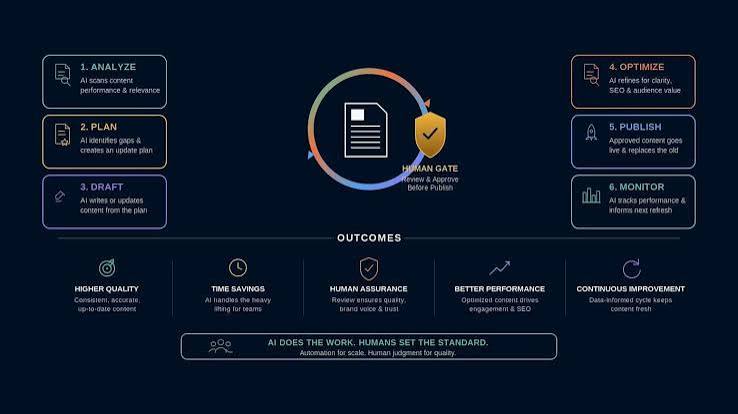
That means three things matter more than headline features: who can create, who can edit, and who can approve. If those permissions are blurry, the tool becomes a liability the first time someone publishes an unreviewed claim, uses the wrong product name, or overwrites a legal note. A clean workflow should make the next step obvious: writer drafts, editor revises, approver signs off, then publish. Microsoft reports that 60% of leaders say their organizations lack innovation because of fragile collaboration, which is one reason workflow clarity matters.
I would not recommend any AI content writer for teams if it cannot separate draft creation from approval. That disqualifies a surprising number of lightweight tools that are fine for solo use but weak for coordinated publishing. They may produce a usable paragraph, but they do not prevent process mistakes. In a team setting, that gap matters more than a clever model name.
The best fit is usually a platform that supports role-based access control, comments, version history, and status stages such as draft, review, approved, and published. If your team already works inside a CMS or a project tool, the writer should fit that system rather than force a second content universe. If it cannot, adoption slows down because people stop trusting where the final version lives.
What permissions should an AI writing tool support?
A useful team tool should support at least four roles: admin, creator, editor, and approver. That is the minimum structure I would look for because it mirrors how content actually moves. Admins set policy. Creators generate drafts. Editors shape voice and structure. Approvers decide whether the piece is safe to publish.
The most important permission is not “can edit text.” It is “can approve publication.” If the same person can draft, rewrite, and approve without trace, you lose accountability. That is fine for a one-person newsletter. It is risky for a brand blog, a regulated industry, or a support knowledge base where errors can outlive the original author.
I also look for document-level and folder-level permissions. Document-level access keeps freelancers or subject-matter reviewers inside a narrow lane. Folder-level access helps when one team owns product pages, another owns help articles, and a third owns campaign copy. If a tool only offers broad workspace access, someone will eventually see or change content they should not.
A good system also records who made each change and when. Version history is not a bonus. It is the only practical way to recover from a bad edit or settle a dispute about what changed in round two. If the tool cannot show the path from draft to approval, your team will end up managing proof in email threads and screenshots.
What I would skip: tools that bundle every permission into one shared team login. That saves setup time and costs you control. A shared login belongs in a small experiment, not in a publishing operation. For teams handling legal or compliance-sensitive material, Adobe’s firefly and content-safety guidance also stresses governance controls, not just generation quality.
Which collaboration features actually matter in daily work?
The best collaboration feature is not live co-editing by itself. It is comment threading tied to a specific version. That lets a reviewer flag a claim, an editor respond, and the writer resolve the issue without losing the rationale. A raw chat stream does not do that. It scatters decisions.
I also care about task status labels and assignment handoffs. If a draft can move from “needs sources” to “legal review” to “approved,” the team spends less time asking where the piece stands. That matters even more when multiple approvers exist, because the bottleneck is usually not generation; it is coordination.
Real collaboration also means the AI can work inside the workflow rather than outside it. A tool that drafts inside the same document where comments and approvals live can reduce version drift, but teams should still check with legal or compliance staff before relying on it for regulated content. The moment a writer copies text from one app into another, context starts to leak. By the time the final draft comes back, nobody is sure which paragraph was approved and which one was improvised. Atlassian’s own collaboration guidance points to the same basic issue: context loss usually comes from tool switching, not from the draft itself.
There is a hidden downside here: more collaboration controls can slow small teams. If two people publish a piece once a month, a six-step workflow may feel like overkill. But if the team ships weekly or handles customer-facing copy, that overhead pays for itself by reducing rework. I would rather see a slightly slower first draft than a public correction later. In a 2023 Asana survey, employees reported spending substantial time on work about work, which is why unnecessary handoffs should be avoided.
A strong collaboration setup should also support external reviewers. Legal, compliance, medical, or partner reviewers often need read-and-comment access without edit rights. If the tool does not allow that distinction, the team either over-shares or works around the system, and both outcomes are bad.
The honest side-by-side
Here is the decision framework I would use when comparing a lighter AI writer with a team-oriented platform.
| Criteria | Solo-style AI writer | Team-oriented AI writer | Winner for this condition |
|---|---|---|---|
| Role-based access | Often minimal or absent | Separate creator, editor, approver roles | Team workflows with multiple reviewers |
| Approval steps | Usually informal | Built-in status gates and sign-off | Anything that must be reviewed before publish |
| Version history | Basic or inconsistent | Tracked changes and rollback | Content with compliance or brand risk |
| Commenting | Often limited | Threaded notes on specific passages | Teams with editors and subject-matter reviewers |
| Folder and workspace control | Light organization | Clear segmentation by team or project | Large content libraries |
| External reviewer access | Hard to manage | Read-only or comment-only access | Legal, HR, or partner review |
| Publishing governance | Manual handoffs | Defined approval chain | Brand-sensitive publishing |
| Setup speed | Fast | Slower to configure | Solo creators or tiny teams |
| Risk of accidental publish | Higher if sharing is loose | Lower if permissions are configured well | Teams that cannot afford mistakes |
The pattern is simple. The lighter tool wins on speed. The team-focused tool wins on control. If you are choosing for a marketing department, a documentation team, or any group that needs sign-off before publication, the second option is the real one.
What the table does not show is the operational cost of bad process design. A well-built team tool can still be misused if nobody defines who approves what. That is why I would treat workflow design as part of the purchase, not an afterthought. A platform may support approvals, but the team still has to decide whether finance reviews pricing copy, whether legal reviews claims, and whether a manager can override an editor.
AI content writer for teams: who should choose the team model?
The team model wins for any group that publishes under a shared brand and needs traceable approvals. That includes B2B marketing teams, agencies handling client work, support documentation teams, and internal communications teams with multiple stakeholders. It also fits regulated or semi-regulated settings where a sentence can create risk. In IBM’s 2024 Cost of a Data Breach Report, the average breach cost reached $4.88 million, which is a reminder that control is not abstract.
The strength of a team model is predictability. A writer can draft against a brief, an editor can apply voice rules, and an approver can check the last mile without guessing what happened earlier. That is especially useful when one person is remote, one is freelance, and one is a domain expert who only reviews twice a week. A clear workflow keeps the job moving.
The weakness is setup drag. A structured tool asks for policy decisions up front: who can create templates, who can publish, what happens when an approver is unavailable, and whether edits after approval force a new sign-off. If the team is too small or too informal, that structure can feel heavy. A two-person startup writing occasional pieces does not need enterprise-grade gates.
I would especially recommend the team model when content lives beyond marketing. If the same system handles help center pages, release notes, and customer-facing announcements, the cost of an error rises fast. In that setting, the extra control is not bureaucracy. It is a guardrail.
Who should skip it? Solo creators, micro-teams, and one-off campaign groups that do not need a formal approval chain. They will pay for controls they never use, and the workflow may slow them down more than it protects.
When a simpler writer is enough
A simpler writer is enough when the content owner is also the approver, the editor, and the publisher. That is the cleanest case for a lightweight tool. If the same person can fix the draft, check the facts, and publish it, then role separation adds little value.
It also makes sense when content volume is low. A team that publishes two pages a month can probably manage with shared folders, manual reviews, and a clear naming convention. Adding formal approval software at that scale can create more process than output.
The main benefit here is speed. A simple writer usually gets a draft on screen faster and with less configuration. For brainstorms, rough outlines, internal notes, and first-pass copy, that can be enough. I would use that kind of tool when the goal is to move from blank page to working draft in minutes, not to build a controlled publishing system.
The weakness is obvious: the moment responsibilities split, the workflow starts to fray. If one person writes, another edits, and a third signs off, manual handoffs turn into missed comments and duplicate drafts. The more stakeholders you add, the more a lightweight tool starts to look like a stopgap.
If your team already has a strong CMS approval process and only wants AI for first drafts, a simpler writer may be the better buy. It can sit upstream of the formal system instead of trying to replace it.
The verdict: which one to choose and why
Choose a team-oriented AI content writer if three or more people touch the same piece and you need approval before publish. Choose a simpler writer if one person owns the whole path from draft to publication and speed matters more than governance. Neither if your team cannot define who may approve content, because a tool will not fix a broken process.
My call is plain: if permissions and approvals matter, pick the team model. If they do not, do not pay for them.
Exception scenarios where the verdict flips
There are a few cases where I would reverse the usual recommendation.
First, a tiny team with strict legal review but very low volume may still do fine with a simpler writer plus a separate approval system in the CMS. If the CMS already handles sign-off cleanly, the AI tool can stay narrow.
Second, a freelance-heavy agency that works across many clients may need a team-oriented platform even if headcount is small. The issue is not employee count; it is how many clients, brands, and reviewers sit inside the same workflow. One client may want comment-only access, another may want final approval in a shared doc, and the tool must handle both.
Third, if your organization has a formal document control standard or recordkeeping requirement, I would favor the stronger governance tool even when the drafts are simple. The workflow itself becomes part of the audit trail.
Fourth, if the AI tool cannot export cleanly into your CMS or project system, I would downgrade it regardless of features. A brilliant drafting surface that does not fit the publishing stack creates duplicate work every week.
The common thread is this: the workflow around the writer matters as much as the writing. When that workflow is complex, choose the controlled option. When it is not, do not buy complexity for its own sake.
How do approvals and permissions usually fail?
They fail when ownership is vague. A draft sits in review because no one knows who gets the final yes. A junior editor updates a page after sign-off because the tool allowed it. A client comments in one place while the working draft lives in another. None of these problems come from the AI itself. They come from missing process design.
The fix is to define four rules before rollout: who may create, who may change, who may approve, and what happens after approval. If the tool supports those rules, good. If it does not, the team will invent them informally and then forget them under deadline pressure.
I would also insist on a single source of truth. One document, one status, one owner. As soon as drafts scatter across chat, email, and duplicate files, nobody can tell which version is current. That is where confusion begins and trust ends.
FAQ
Can one AI writer serve both marketers and legal reviewers?
Yes, if it supports separate roles, comment-only access, and a locked approval stage. If not, the review process will be too loose.
Do small teams really need approval workflows?
Not always. If one person owns the content end to end, a formal workflow may be unnecessary.
Drafted with AI; not yet reviewed by a person.