How to Edit AI-Generated Copy So It Sounds Human
Last updated: October 10, 2026
Key Takeaways
- AI copy sounds machine-written when it is polished but generic, with no clear voice or intention.
- Edit in three passes: remove fluff, shape the voice, then check each sentence earns its place.
- When the draft is meant to rank, keep search intent but make headings and examples more specific.
- The best edits add judgment, friction, and natural variation.
Quick Answer

Quick answer: to edit AI-generated copy so it sounds human, make about 3 targeted passes: cut generic lines, add specific nouns and judgment, and vary sentence length.
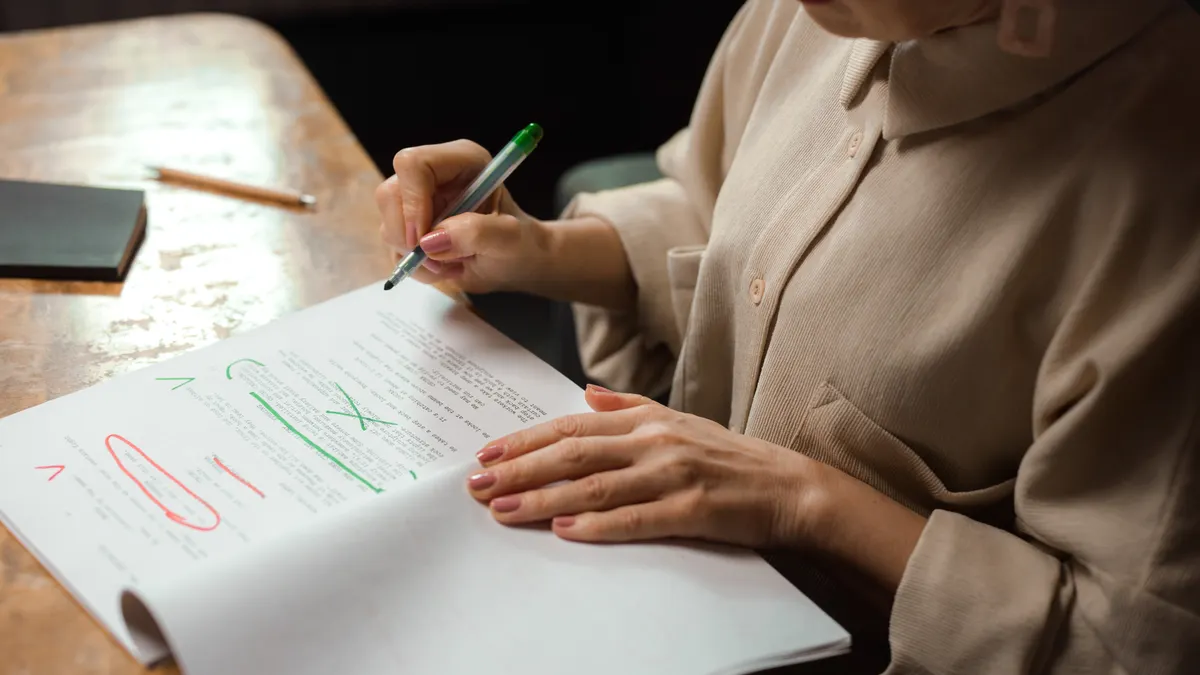
Editing AI-generated copy so it sounds human starts with one blunt rule: keep the useful structure, then strip out the parts that could belong to any draft. The fix is not “make it more creative.” Instead, sharpen specificity, point of view, and sentence shape until the text feels like it came from someone with a reason for every line.
What actually makes AI copy sound machine-written?
AI copy sounds machine-written when every sentence is grammatically correct but none of them feels chosen. A draft that could describe any product, any service, or any audience needs a human pass, not a light proofread.
The biggest tells are easy to spot:
- Broad claims with no concrete detail
- Repeated sentence lengths and rhythm
- Samey transitions that sound like a template
- “Business English” words where plain words would do
- Confidence without stakes
Take a line like “This tool helps teams improve productivity.” Which teams? Improve what part of productivity? And what changes in daily workflow? You do not need a fake statistic; you do need a real noun. “A sales team can cut meeting prep from 30 minutes to 10 minutes” sounds human because it is visible and testable.
Over-explaining is the other trap. AI often gives the motive, the benefit, and the summary in one breath, then repeats itself a sentence later. People usually don’t talk that way. They cut to the point first, then unpack it only if needed.
Here is the fast rule I use: a sentence that would not survive being said aloud at a desk, in Slack, or in a client review needs work. That does not mean slang. It means pressure; a human sentence usually has an opinion, a detail, or a reason to exist.
Quick check: this section is the one to fix first if your draft reads politely but could belong to any brand in your industry.
How do I edit AI-generated copy step by step?

Cut the generic layer first, then rewrite for voice, then check whether each sentence earns its place. Trying to humanize before you prune usually just decorates a bad draft.
Start with a hard pass. Read the draft once and mark every sentence that sounds vague, inflated, or empty. Then use this order:
- Delete filler claims. Cut lines like “in today’s world,” “it is important to note,” and “in many cases” unless they carry real meaning.
- Replace abstractions with nouns. Change “improve performance” to “reduce checkout errors,” “shorten onboarding calls,” or “answer support tickets faster.”
- Break up perfect rhythm. Mix short sentences with medium ones. Should three consecutive lines sound alike, rewrite at least one.
- Add a point of view. Say what you would choose, what you would avoid, or what the trade-off is.
- Check the verbs. Swap weak verbs like “is,” “has,” and “makes” for sharper ones where possible.
- Read it aloud. Any line that trips your mouth is a good candidate for a rewrite.
- Do a final specificity pass. Every section should contain at least one concrete detail: a duration, number, standard, tool name, format, or workflow step.
A useful benchmark is the Hemingway Editor’s readability signal: if the copy feels dense in the app, it will usually feel dense to a reader too. I would not worship a grade level, but I would treat it as a warning light.
This is also where tools like Grammarly or ProWritingAid help in a limited way. They catch clutter. They do not decide whether a sentence sounds alive. That part is still on you.
Quick check: when the draft is accurate but dull, or polished but soulless, start with this workflow.
If the draft is for SEO content, what should change?
Keep the search intent, but make the examples, headings, and subpoints more specific than the AI draft probably is. Search engines do not reward “human” as a vibe; they reward usefulness and coverage.
For SEO copy, the danger is over-editing into something clever but less findable. I would not strip every repeated keyword if the repetition is natural. I would cut keyword stuffing that reads like a machine trying to obey instructions. If the phrase “edit AI-generated copy” belongs in the opening, one H2, and the conclusion, that is normal. If it appears eight times in 900 words, that is not.
Use this path when the draft is for a blog post, service page, or knowledge article:
- Keep the search term where it helps. Put the core phrase in the title, opening paragraph, and at least one H2 if it fits naturally.
- Answer the likely follow-up questions. For this topic, that means voice, structure, examples, and common mistakes.
- Choose one reader level. Do not explain copyediting as if the reader has never edited a paragraph before and also assumes they know what “brand voice” means.
- Use visible proof, not hype. Mention tools such as Google Docs Suggesting mode, Hemingway Editor, or the AP Stylebook as relevant references, not as props.
- Remove repetition that does not serve navigation. If two sections say the same thing in different words, keep the stronger one and move on.
- Close gaps that a searcher would notice. If the page promises editing advice, include a checklist, a workflow, and a section for edge cases.
One honest trade-off: SEO-friendly human editing can feel less “brand-y” than a polished marketing rewrite. That is fine on informational pages. A searcher usually wants clarity before flair. I would choose clarity for educational content and save the stylistic polish for a homepage or campaign page.
For source material, I trust plain, durable references here more than trend pieces. The AP Stylebook and Merriam-Webster are useful for word choice and consistency; Google’s own Search Central guidance is worth consulting when the copy has to serve search intent. For search intent and structure, Google’s Search Central documentation is a better anchor than guessing what might rank.
Quick check: when the draft is supposed to rank on a query, and it already has the right subject but not enough useful detail, this is the path to take.
Which edits make AI copy sound like a person?
The edits that make AI copy sound like a person are the ones that introduce judgment, friction, and natural variation. If every paragraph feels smoothed flat, the fix is not more adjectives; it is sharper choices.
I would focus on these four moves:
1. Replace corporate fog with concrete language.
“Optimize your workflow” becomes “cut the weekly status call from 45 minutes to 20.”
“Enhance user satisfaction” becomes “reduce the number of support emails about password resets.”
2. Add a real preference.
Humans choose. AI drafts often float. Say, “I would keep this sentence,” or “I would cut this because it repeats the heading.” A clear preference gives the copy a spine.
3. Use contractions and mixed sentence length.
“Do not” and “don’t” are both correct in many contexts; the point is not the apostrophe, it is the cadence. A paragraph with one short, blunt sentence usually sounds more human than one made of evenly padded lines.
4. Let one idea lead.
AI copy often stacks three near-synonyms into one sentence. Humans usually pick the strongest and move on. “Fast, efficient, and streamlined” is almost never as good as “fast.”
Here is a quick comparison:
| Situation | Best Path | Why Other Options Fail |
|---|---|---|
| The draft is technically correct but flat | Rewrite for specificity and voice | Light proofreading leaves the machine tone intact |
| The draft is full of buzzwords | Translate claims into plain nouns and verbs | Buzzwords hide meaning instead of improving it |
| The draft sounds too formal | Add contractions, shorter sentences, and direct judgments | Formally “correct” prose can still sound artificial |
| The draft is repetitive | Merge duplicate points and cut near-synonyms | Repetition makes the writing feel generated, not shaped |
One place I would not overdo it: slang. Trying to sound “relatable” can turn into forced internet speech fast. A human voice is not the same thing as a casual voice. Strong editing should sound natural, not performative.
Quick check: when your copy feels like it was written by a committee that all use the same template, these are the edits that matter most.
When the standard advice is wrong
The standard advice is wrong when the draft is already clear and the real problem is not humaneness, but fit. Rewrite without checking the job of the page, and you can break good copy.
Here are the edge cases where I would change course:
-
The piece is legal, medical, or financial.
What changes: accuracy outranks personality.
What to do instead: keep the tone plain, remove puffery, and add a professional-consultation hedge where needed. I would not try to “warm up” a medical explanation with cleverness. -
The copy is for a luxury or enterprise brand.
What changes: the voice may need restraint, not chatty energy.
What to do instead: tighten the language, remove clichés, and keep the prestige cues deliberate. A casual rewrite can cheapen the brand. -
The draft is a policy page or support article.
What changes: users want certainty more than style.
What to do instead: keep headings literal, use step-by-step instructions, and avoid metaphors that slow scanning. -
The copy is a landing page with one conversion goal.
What changes: every extra line competes with the CTA.
What to do instead: cut side notes, keep proof tight, and preserve the strongest benefit statement. -
The audience is expert.
What changes: over-explaining becomes insulting.
What to do instead: use the field’s actual terms, keep the sentence structure clean, and skip elementary definitions unless they solve a real ambiguity. -
The AI draft is already good.
What changes: a heavy rewrite can damage a usable base.
What to do instead: do a light edit for rhythm, specificity, and fact checks. Not every draft needs surgery.
The point is matching the edit to the purpose. If a reader needs reassurance before a purchase, a little warmth helps. If the reader needs instructions in 3 steps, warmth gets in the way.
Quick check: when the page has a regulated topic, an expert audience, or a single conversion goal, do not use generic “make it more human” advice.
What should I cut first from AI-generated copy?
Cut the lines that sound impressive but do not move the reader forward. If a sentence exists mainly to sound professional, it is probably disposable.
My first pass usually removes:
- Empty scene-setters like “in today’s digital landscape”
- Repeated transitions that signal AI, not logic
- Triple adjectives that slow the line down
- Summary sentences that repeat the heading
- Generic benefit statements with no example
- Overlong intros that delay the point
A practical way to edit is to read each paragraph and ask: if I deleted this, would the reader lose information or only lose atmosphere? If it is only atmosphere, cut it. A 12-word sentence with one exact detail will usually beat a 28-word sentence full of air.
You can also use a simple benchmark: if a paragraph contains no named tool, no measurable step, no concrete scenario, and no real choice, it is probably underwritten. That does not mean every paragraph needs a number or a brand name. It means every paragraph should contain something a reader could act on or picture.
For AI drafts, I am especially skeptical of openings that spend about 100 words framing the topic. Most of the time, the framing is the fluff. Lead with the answer, then explain the why.
Quick check: if you can delete a sentence and the page still feels the same, the sentence probably should go.
FAQ: How do I know if the copy sounds human?
It sounds human if a real person could have said it, defended it, and shortened it. If a sentence feels like it was written to satisfy a prompt instead of a reader, it still needs work.
How much should I rewrite AI copy?
As much as needed to remove generic phrasing, flatten repetition, and add concrete detail. If the draft is only a rough outline, expect a deeper rewrite than if it is already well-structured.
Should I always change the AI wording?
No. If a sentence is clear, accurate, and natural, keep it. Good editing protects strong lines instead of replacing them for the sake of it.
What is the fastest way to humanize copy?
The quickest way is usually to replace abstractions with specific nouns, shorten one or two sentences in each paragraph, and add one clear judgment per section.
Can AI copy sound human without being rewritten?
Sometimes, but not often enough to trust blindly. For public-facing content, I would do a human edit pass.
What tool should I use first?
Google Docs for clean rewriting, Hemingway Editor for sentence clutter, and a style reference such as AP Stylebook or Merriam-Webster for consistency. Tools help, but they do not make judgment calls for you.
The strongest edit is the one that makes the reader forget there was ever a machine in the middle. Keep the useful parts, cut the dead weight, and write like someone who has something specific to say.
Drafted with AI; not yet reviewed by a person.

Related Posts

AI Content Writer Tools for Social Media Captions